Mi’kmaq legend, Glooscap and the Bay of Fundy

hist_thumb

Gerald Gloade is a guardian of history. But the history he preserves is not one you’ll find in many textbooks. It has been handed down from one generation to the next by storytellers very much like him. It is a history rich in the heritage and culture of the First Nations people who lived around the Bay of Fundy for centuries before the first European settlers arrived: the Mi’kmaq.

For Gloade’s ancestors, the Bay of Fundy was their lifeblood. “It sustained them during spring, summer and fall,” says the famed artist and member of the Millbrook First Nations band. “Eighty percent of the time, they lived off of the sea, and drew on its resources. And it was a major travel route for meetings and social gatherings.”

The stories entrusted to Gloade go far beyond the particulars of the day to day lives of the Mi’kmaq. They touch upon the forces that shaped the Bay of Fundy as we know it. Though there are more legends about this region than can be retold here, there is one thing many have in common – the influence of the heroic Mi’kmaq figure Glooscap on the landscape.

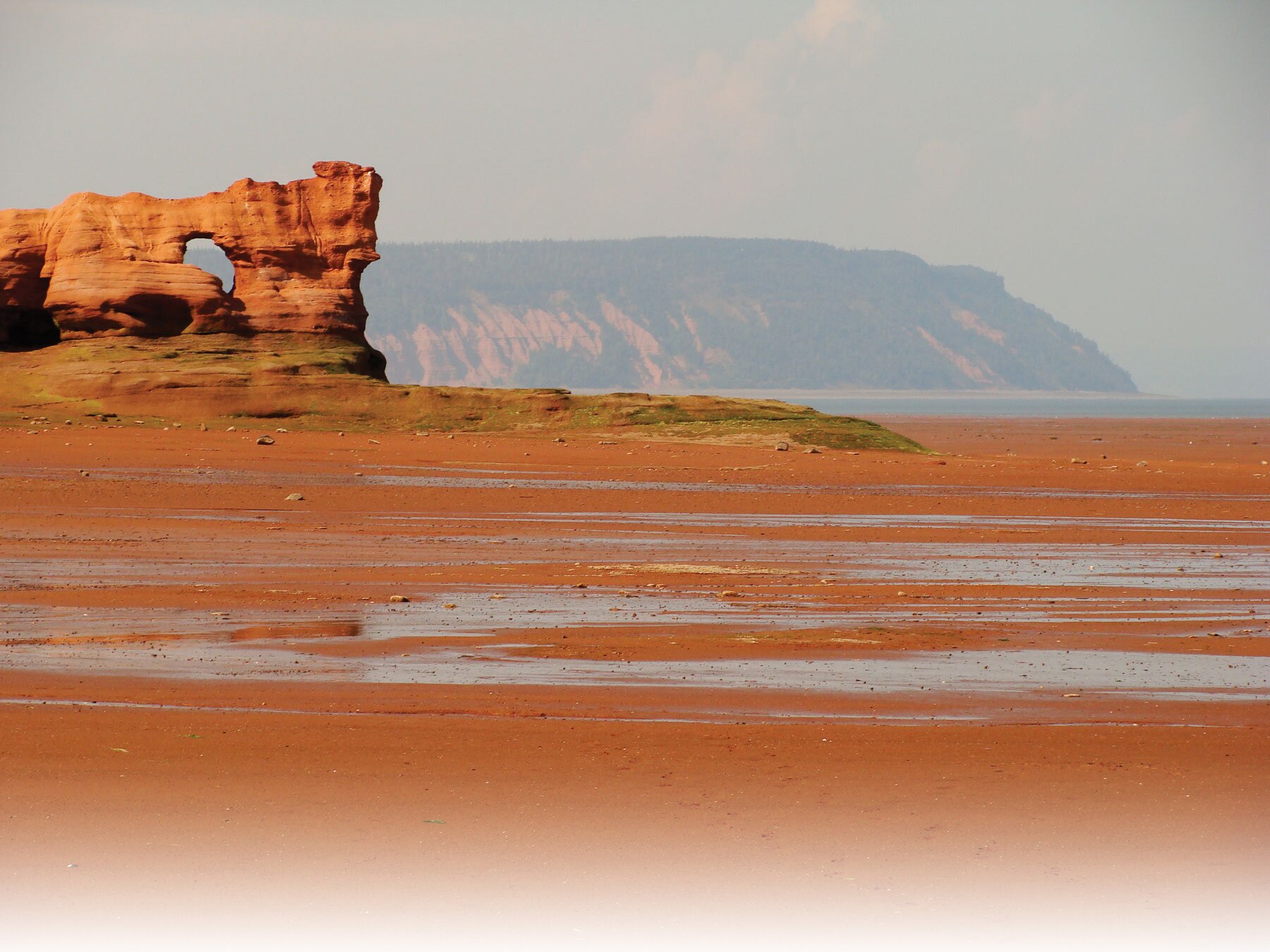
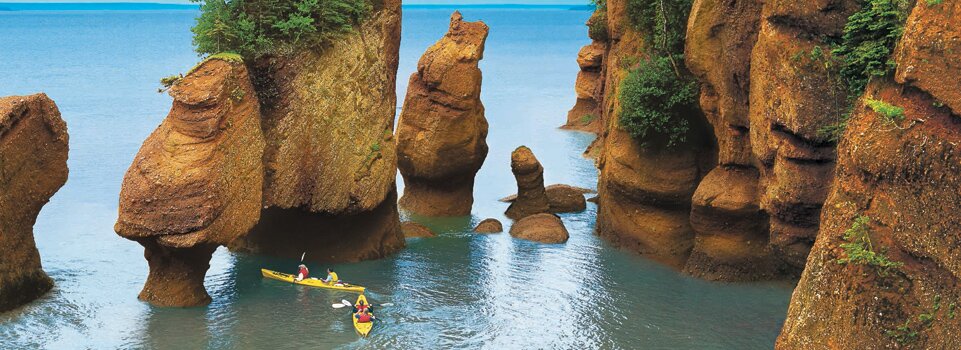
Take the Five Islands, which form a chain in the Minas Basin. “They were created when Glooscap threw five clods of mud at a beaver,” says Gloade.  Two boulders at Cape Split were once pet wolves that Glooscap turned to stone, “and you can still see them, howling silently.” Or, consider the story of Partridge Island. It seems Glooscap’s grandmother maintained a large pot of food there that ‘never emptied. If you cut off a piece of stew meat, it would grow back.”

Yet the stories that most excite the imagination are the ones that dovetail with the textbooks and findings of researchers in unexpected ways. For example, Gloade says that Glooscap once fought the god of winter and lost, which resulted in a year without four seasons. “There are soil experts who have identified a layer of sediment with no trace of pollen or vegetation, and that was only 2000 years ago.”

Then there is the story of Jipijkan, a horrible monster that made the ground around the Bay of Fundy shake when he moved. “He had two horns: one was red; the other yellow. He hissed like a serpent, and when he did, he could take away your ability to speak or breathe.”

As it turns out, the Bay of Fundy did rip open 6,000 years ago, releasing poisonous vapours. “We have Mi’kmaq artifacts dating back 13,000 years, so we were here when it happened. Jipijkan was a way to tell children to run if they heard the earth rumbling to avoid those vapours.”

There are many more stories to tell, and Gloade will be crisscrossing Nova Scotia during Mi’kmaq History Month in October to pass on the legends and traditions of his ancestors to a new generation.

“They are still significant, and many of the materials that were vital to us, from the medicinal plants to the basalt rocks we used for fires, are still here all around the Bay of Fundy. This is our culture and it is important to maintain and acknowledge it.”

Round the Bay

  • “We were just there last week and camped at the Glooscap campground (beautiful) and went to Spencer’s island and beautiful Cap D’or…which brought back special memories of my childhood days, of my parents taking us there almost every summer….It is so beautiful all around there ! :-) ”- Charlotte, Dieppe NB


  • “So many of my memories have taken place along the shore of the Bay of Fundy that I cannot even begin to recollect them all. It truly is a magnificent natural wonder, and something that is dear to my heart.” – LittleGrayBird.ca, Winnipeg, MB


  • “Since the late 1800s, many authors became entranced by the stories of the Mi’kmaq and with this increase in awareness Glooscap’s accomplishments grew. Yet he still embodies the fundamental attribute of wisdom and hope.” – GlooscapHeritageCentre.com, Millbrook NS
Sponsored by